
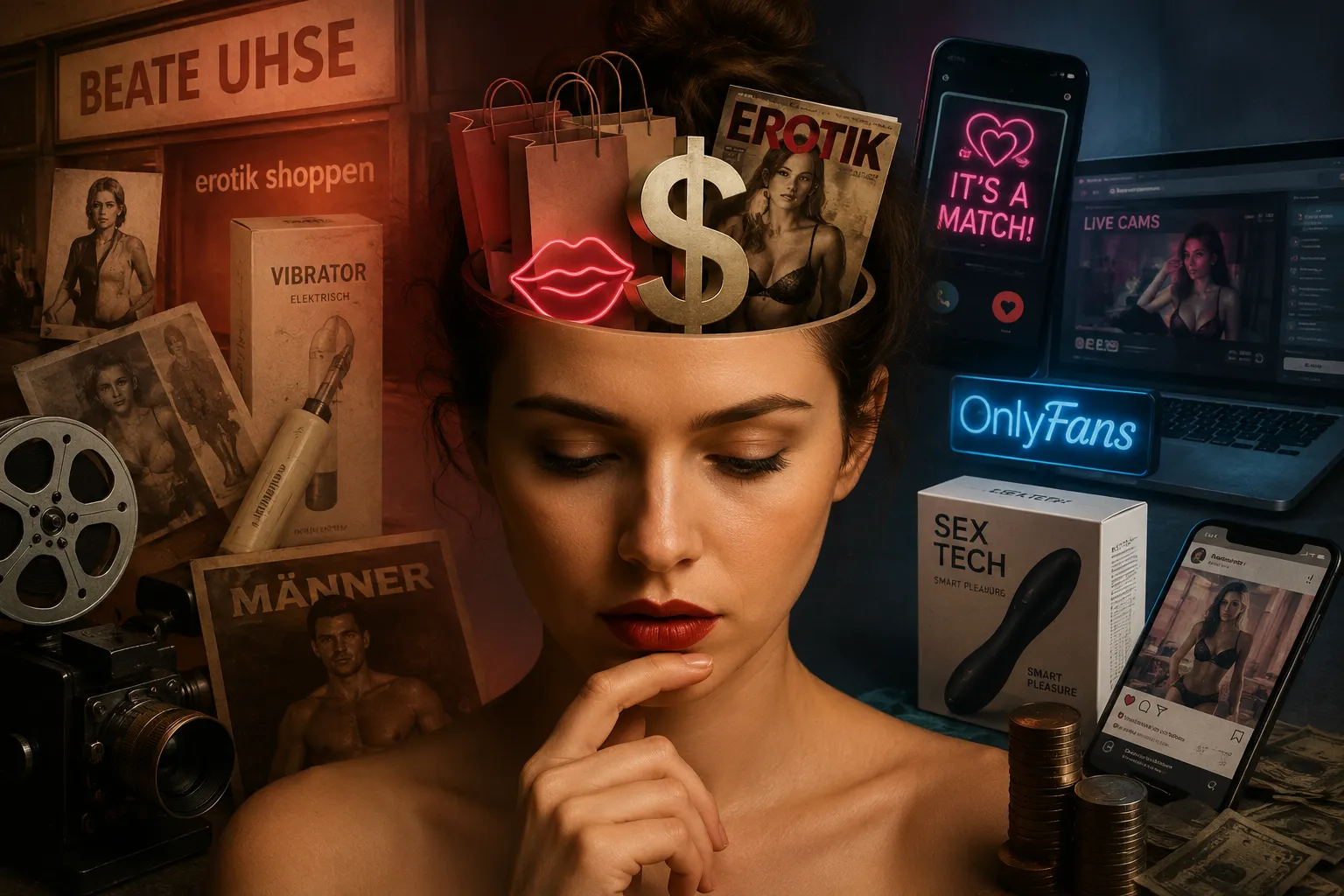
We often regard our intimate desires as something deeply personal and innate. Yet how free are our erotic longings in reality? A recent review on H-Soz-Kult discussing the scholarly anthology Socio-Economics of Sexualities in the 20th Century (Sozioökonomie der Sexualitäten im 20. Jahrhundert) raises precisely this fundamental question. The contributing historians compellingly argue that sexuality has never been merely a private matter. Politics, commerce, advertising, and technological innovations have continuously dictated what people perceive as desirable, normal, or aspirational over the course of decades. Those who commercialize sexuality rarely sell mere commodities—they actively mold our foundational assumptions about what pleasure truly means.
Sexuality Is Inherently Economic
When contemplating sexuality, most people envision love, romantic partnership, or innate biological drives. Historically, however, it represents a tremendously influential economic sector. The anthology highlights numerous twentieth-century developments illustrating this intricate entanglement:
- The formalization of sex work as an organized economic industry.
- The post-war rise of commercial erotic mail-order enterprises, exemplified by Beate Uhse in Germany.
- The mass production and marketing of vibrators and intimate wellness devices.
- The industrial distribution of erotic literature, magazines, and adult films.
- The strategic incorporation of sexualized imagery into mainstream corporate advertising.
The core scholarly conclusion is unambiguous: our concepts of sexuality do not develop in a vacuum. They are continuously negotiated and configured by societal and economic forces.
Desire Sells—and Has for More Than a Century
While the maxim “sex sells” is familiar from modern marketing campaigns, the underlying mechanics date back far longer. By the dawn of the twentieth century, eroticism was already leveraged systematically to capture attention, enhance product desirability, or monetize newly emerging social appetites.
With every technological breakthrough, novel marketplaces for human desire arose in tandem: from still photography and early cinema to phone sex lines, specialty magazines, and modern dating platforms, streaming subscriptions, sex tech, and Artificial Intelligence. Each wave of technological disruption did not merely widen accessibility; it actively transformed interpersonal expectations, erotic fantasies, and cultural body standards.
Who Dictates How We Think About Sex?
The pivotal question is not merely who sells sex, but rather: Who dictates how we think about sex? Economic interests exert profound power over which fantasies become visible within the mainstream and which remain marginalized.
This does not imply a malicious conspiracy. Commercial enterprises naturally adapt to pre-existing consumer demand. However, commercially successful products simultaneously stimulate new consumer desires, producing a self-reinforcing feedback loop between supply and psychological demand. In psychology, this mechanism is recognized as social learning: individuals calibrate their desires against what is continually modeled, depicted, and consumed around them. Over time, this shifts societal norms, personal boundaries, and our most intimate ideals.
Mechanisms in the Digital Age
These dynamics remain fully operational today—only the distribution channels have changed. Social networks, dating apps, content creators, platforms like OnlyFans, and AI-generated imagery now serve as primary cultural arbiters. Every single day, they influence which body archetypes dominate our feeds, which practices are categorized as “normal,” and what narratives of emotional intimacy are conveyed.
Not every commercial evolution is inherently detrimental or beneficial. The critical task is cultivating awareness: recognizing that our personal desires are always nurtured and negotiated within a specific cultural and economic climate.
The LustLink Perspective
This reality forms the core conviction at LustLink: authentic, unscripted communication is vastly more meaningful than transient commercial fads. There is simply no objectively “correct” or “standardized” sex life. Individuals diverge immensely across desires, boundaries, fantasies, relationship models, and emotional needs. Complications arise precisely when people feel compelled to conform to artificially manufactured commercial or social expectations.
LustLink deliberately pursues a radically distinct path. Our platform refuses to moralize preferences or prescribe trends. Through encrypted, data-driven matching, it focuses solely on highlighting where two unique individuals genuinely align.
Neither advertisements, social media algorithms, nor cultural pressures should dictate what brings you joy—that belongs solely to you and your partner.
Science Over Moralizing
The anthology adopts a refreshingly sober analytical lens. Rather than evaluating sexuality through a moralizing framework, the researchers analyze it as a neutral, multifaceted social phenomenon. This scholarly approach unlocks fascinating inquiries: Why are certain practices embraced while others are tabooed? Why do beauty ideals continually shift? And why is sex tech experiencing such exponential growth today?
It is precisely this empirical detachment that makes this historical scholarship so valuable. It demonstrates that the history of sexuality is inextricably intertwined with economic, media, and cultural history. We ought to celebrate and explore our desires consciously—ensuring that the market never defines our fulfillment, but that we define it for ourselves.
Read More
Making sure you're not a bot!
References:
- H-Soz-Kult: Review of Sozioökonomie der Sexualitäten im 20. Jahrhundert.
- Horntrich, Paul M.; Lehner, Nora M. (Eds.): Sozioökonomie der Sexualitäten im 20. Jahrhundert. Böhlau Verlag, 2025.
Research and draft supported by AI, editorially reviewed.
Helpful article?
Loading ratings...