
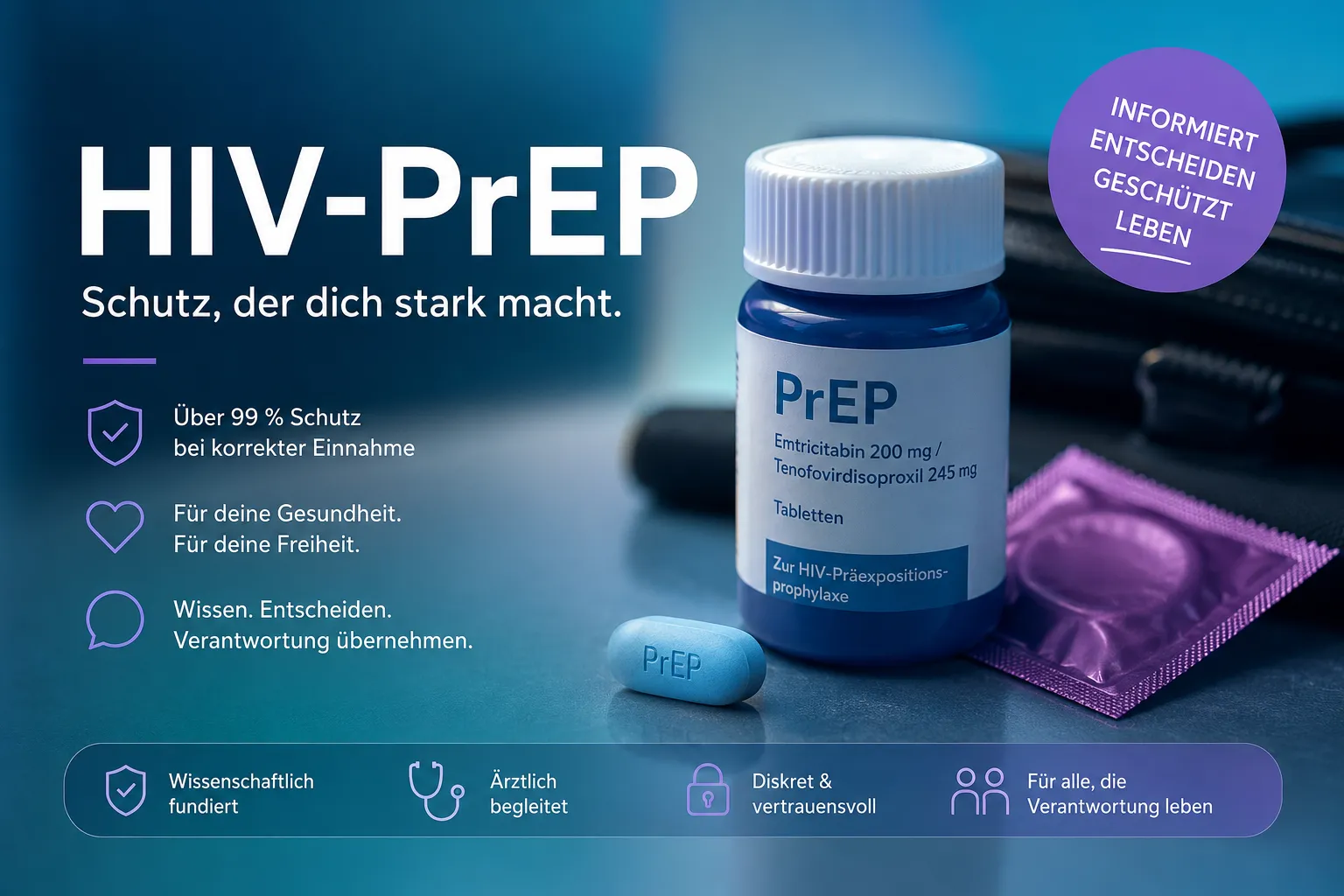
HIV PrEP – The Comprehensive Practical Guide
HIV pre-exposure prophylaxis (PrEP) is among the greatest triumphs of modern infectious disease medicine. When used correctly, it prevents sexual transmission of HIV with an efficacy exceeding 99%. Nevertheless, it is not equally necessary for everyone.
For many, the mention of HIV still evokes imagery from the 1980s: overcrowded hospital wards, a baffling immunodeficiency syndrome, and an illness that for years was virtually an automatic death sentence. That collective memory continues to shape public perception today—even though medicine has advanced beyond recognition over the past four decades.
Today, individuals diagnosed early and maintained on consistent antiretroviral therapy achieve a life expectancy virtually indistinguishable from that of the general population. Even more momentous, however, is a preventive breakthrough: HIV infection can now, in most instances, be averted before initial contact with the virus ever takes place.
This is the precise domain of Pre-Exposure Prophylaxis, commonly known as PrEP.
It represents one of the most effective preventive interventions ever developed in clinical medicine. Millions worldwide now integrate it successfully as a core element of their personalized sexual health strategy.
PrEP is not intended to displace condoms or other preventive measures. Rather, it broadens the repertoire of responsible options for managing sexual health autonomously.
Individuals with dynamic sex lives frequently grapple with common questions:
- Do I actually need PrEP?
- What medications are available?
- What side effects are clinically realistic?
- Does health insurance cover the expenses?
- What alternatives exist?
This guide addresses these questions based on current scientific consensus, offering clear, objective guidance for anyone seeking to make an informed choice—regardless of sexual orientation or lifestyle.
Why This Matters on LustLink
Sexual compatibility encompasses far more than shared fantasies.
It equally requires mutual trust, transparent communication, and shared responsibility for intimate well-being.
Consequently, conversations regarding HIV status, STI screenings, barrier methods, and PrEP have become standard facets of getting to know someone for many sexually active adults.
On LustLink, two partners independently explore and indicate their erotic interests. Only mutual preferences are revealed. This design fosters candid conversations about desires, boundaries, and safety preferences—well before meeting in person.
Sexual health is not a mood killer; it is a fundamental expression of mutual care and respect.
What Exactly Is HIV PrEP?
The acronym PrEP stands for Pre-Exposure Prophylaxis.
Its etymology reflects its clinical mechanism:
- Pre = prior to
- Exposure = potential contact with HIV
- Prophylaxis = preventive intervention
The medication is taken prior to potential exposure to HIV.
If the virus subsequently enters the body, active pharmaceutical agents are already present in target tissues to block viral replication. As a result, the infection cannot establish itself in the host genome.
PrEP is not a vaccine.
While vaccines stimulate the adaptive immune system to produce antibodies, PrEP acts directly as a biochemical barrier inhibiting the enzymatic machinery of viral replication.
How Effective Is PrEP?
Extensive international clinical trials have consistently demonstrated:
When taken with high adherence, PrEP reduces the risk of acquiring HIV through sexual contact by more than 99%.
Adherence is the defining determinant of efficacy.
Missed doses or uncoordinated interruptions can compromise protective drug concentrations in tissue.
Mathematically, transmission risk can be conceptualized as:
$$ P(\text{Infection}) = P(\text{Exposure}) \cdot P(\text{Transmission}) \cdot P(\text{Viral Replication}) $$
PrEP acts decisively upon the final term.
By shutting down viral reverse transcription, the probability of establishing systemic infection approaches zero under consistent adherence.
What Does PrEP Protect Against?
A widespread misconception requires clarification:
PrEP protects exclusively against HIV.
It provides no protection against other sexually transmitted infections (STIs).
These include:
- Syphilis
- Gonorrhea
- Chlamydia
- Hepatitis C
- Mycoplasma genitalium
- Mpox
- Human papillomavirus (HPV)
- Genital herpes (HSV)
For this reason, regular comprehensive STI screenings remain a mandatory, non-negotiable component of any PrEP protocol.
The Genesis of PrEP
The development of PrEP is inextricably linked to the trajectory of the HIV pandemic.
When unusual clusters of opportunistic infections were first identified in the early 1980s, few foresaw the onset of one of history’s most devastating modern pandemics.
In 1983, French researchers isolated the human immunodeficiency virus.
Initial monotherapies emerged shortly thereafter.
While early antivirals slowed disease progression, they carried severe toxicities and failed to provide lasting suppression.
The definitive breakthrough arrived in the mid-1990s:
The introduction of combination antiretroviral regimens.
Known as Highly Active Antiretroviral Therapy (HAART), this advance transformed HIV from a fatal diagnosis into a manageable chronic condition.
As clinicians gained deeper insight into viral kinetics, a compelling question arose:
If antiretrovirals can suppress an established infection, could prophylactic tissue concentrations prevent the virus from ever gaining a foothold?
This hypothesis established the foundation of modern PrEP.
The Clinical Breakthrough
In 2010, the New England Journal of Medicine published the landmark iPrEx trial.
It remains a watershed moment in infectious disease prevention.
The trial unequivocally proved:
Participants who adhered faithfully to the medication regimen experienced dramatically lower rates of HIV acquisition compared to the placebo cohort.
Subsequent trials (including PROUD, IPERGAY, and DISCOVER) swiftly validated these outcomes across diverse populations.
Today, PrEP is endorsed as a standard prevention standard by the World Health Organization (WHO), the CDC, the European AIDS Clinical Society (EACS), and public health institutes worldwide.
Who Benefits Most from PrEP?
A central tenet of modern sexology and medicine is:
PrEP is not universally necessary for everyone.
Eligibility is determined not by identity or sexual orientation, but by objective exposure risk.
PrEP is strongly indicated for:
- Men who have sex with men (MSM) with multiple or dynamic sexual partners.
- Individuals with HIV-positive partners who do not have a sustained, undetectable viral load.
- People who frequently engage in condomless anal intercourse.
- Individuals with multiple casual sexual partners within short intervals.
- Sex workers.
- People with recurrent diagnoses of bacterial STIs (e.g., rectal chlamydia, gonorrhea, or syphilis).
- Individuals who participate in chemsex.
- Anyone whose partners’ HIV and viral load status is frequently unknown.
Individual circumstance—not categorical labels—drives clinical relevance.
For example, a heterosexual couple engaging in non-monogamy or group sex may derive far greater clinical benefit from PrEP than a gay couple in a long-standing, strictly monogamous partnership.
When Does PrEP Offer Little Additional Benefit?
Evaluating when PrEP is clinically superfluous is equally critical.
In many contexts, PrEP provides negligible added protection, such as:
- Mutually monogamous relationships where both partners are confirmed HIV-negative.
- Relationships where an HIV-positive partner has an undetectable viral load (U = U).
- Consistent, correct condom usage across all sexual encounters.
- Infrequent or absent exposure scenarios.
- Low-incidence risk contexts.
Decisions should always be formulated in consultation with a qualified healthcare professional.
Key Takeaway: PrEP is not a lifestyle novelty; it is a potent clinical preventive tool. Its maximum value is realized where tangible HIV exposure risk exists.
Medications Used for PrEP
PrEP relies on antiretroviral agents originally formulated for HIV management, administered at specific prophylactic dosages to intercept infection at its earliest cellular stage.
Approved PrEP formulations target the viral life cycle. Following sexual exposure, active drug metabolites prevent the virus from transcribing its RNA into host cellular DNA.
Currently, three therapeutic modalities are prominent in clinical practice.
Emtricitabine + Tenofovir Disoproxil Fumarate (TDF/FTC)
This combination represents the global gold standard of oral PrEP and remains the most widely prescribed regimen.
Originally marketed under the brand name Truvada®, it is now widely accessible as affordable, bioequivalent generics following patent expiration.
The regimen combines two active reverse transcriptase inhibitors:
- Emtricitabine (FTC)
- Tenofovir Disoproxil Fumarate (TDF)
Both belong to the Nucleoside/Nucleotide Reverse Transcriptase Inhibitor (NRTI) class.
Advantages
- Backed by extensive long-term clinical trial data.
- Over 15 years of real-world clinical experience.
- High, proven efficacy exceeding 99%.
- Widely available as low-cost generic formulations.
- Universally endorsed across international clinical guidelines.
Potential Adverse Effects
The overwhelming majority of users experience no serious adverse events.
Documented, infrequent side effects include:
- Mild, reversible reductions in renal clearance (eGFR).
- Slight, non-progressive decreases in bone mineral density.
- Transient gastrointestinal upset (nausea, loose stools).
- Mild tension headaches during the initial days of initiation (“start-up syndrome”).
For these reasons, baseline and quarterly renal monitoring constitutes standard clinical care.
Emtricitabine + Tenofovir Alafenamide (TAF/FTC)
A second-generation oral formulation combines:
- Emtricitabine (FTC)
- Tenofovir Alafenamide (TAF)
Marketed under the brand name Descovy®.
The pharmacokinetic innovation of TAF lies in its ability to concentrate active tenofovir diphosphate within lymphocytes and macrophages more efficiently, enabling a roughly 90% lower plasma concentration.
Advantages
- Reduced renal biomarker impact.
- Favorable bone mineral density profile.
- Equivalent preventive efficacy for receptive anal intercourse.
Disadvantages
- Substantially higher cost (patent-protected).
- Less aggregate long-term longitudinal data.
- Not universally approved for all populations; limited clinical trial data for receptive vaginal intercourse.
For most patients, generic TDF/FTC remains the preferred first-line therapy.
Long-Acting Injectable Cabotegravir
Among the most promising advances in modern prevention is injectable Cabotegravir (Apretude®).
Rather than daily oral tablets, it is administered as a long-acting intramuscular injection into the gluteal muscle.
Following an initiation schedule, injections are administered once every two months.
Advantages
- Eliminates the cognitive burden of daily pill adherence.
- Overcomes adherence fatigue and missed doses.
- Sustained, steady therapeutic tissue levels.
- Ideal for individuals who struggle with daily oral medications.
Disadvantages
- Requires bimonthly clinical appointments.
- Significantly more expensive.
- Limited availability and insurance coverage in certain jurisdictions.
- Extended pharmacokinetic tail: the drug persists at subtherapeutic levels for months after discontinuation, requiring oral bridging if stopped.
Global trials (HPTN 083 and 084) demonstrated non-inferiority—and in some cohorts superiority—compared to daily oral TDF/FTC, primarily due to adherence advantages.
Depot injectables are poised to play an increasingly central role in global prevention over the coming decade.
PrEP Dosing Schedules
Depending on lifestyle and sexual patterns, two evidence-based dosing schedules are established.
Daily PrEP
Daily dosing is the most common regimen worldwide.
It entails taking one tablet daily, approximately at the same time each day.
A steady-state therapeutic concentration is reached after several days.
Advantages
- Highest and most consistent protective efficacy.
- Straightforward routine.
- Accommodates spontaneous sexual activity at any time.
- Requires no advance planning.
Particularly recommended for:
- Individuals with frequent or unpredictable sexual activity.
- Those with multiple partners.
- Individuals practicing receptive vaginal intercourse.
On-Demand PrEP (The 2-1-1 Event-Driven Schedule)
For individuals with intermittent or planned sexual encounters, the event-driven (2-1-1) schedule offers an effective alternative:
- 2 tablets taken between 2 and 24 hours prior to sexual activity.
- 1 tablet taken 24 hours after the initial double dose.
- 1 tablet taken 48 hours after the initial double dose.
This regimen has been robustly validated in cisgender men who have sex with men (MSM).
Daily dosing remains standard for cisgender women, trans men, and individuals engaging in vaginal sex, due to differing tissue distribution kinetics in the female genital tract.
Event-driven PrEP should always be undertaken under medical guidance.
Time to Protection
Achieving protective tissue concentrations varies by anatomical site:
- Receptive Anal Sex: Maximum protection is achieved after approximately 7 consecutive days of daily dosing.
- Vaginal Sex: Protection requires approximately 21 consecutive days of daily dosing to attain steady-state mucosal concentrations.
- Intravenous Exposure: Also requires extended daily adherence.
Individuals initiating PrEP should be mindful of these pharmacodynamic timelines and consult their physician.
What If You Miss a Dose?
An isolated missed tablet does not immediately compromise immunity.
Nonetheless:
Consistent adherence guarantees maximum protection.
If doses are missed repeatedly, practical adherence strategies should be discussed with your physician:
- Smartphone medication alarms.
- Daily pill organizers.
- Linking intake to entrenched daily rituals (e.g., brushing teeth).
How to Access PrEP
PrEP is a prescription-only medication.
Initiation requires comprehensive clinical evaluation by an experienced physician, such as:
- Specialized infectious disease clinics.
- HIV specialty practices (Schwerpunktpraxen).
- Knowledgeable general practitioners, urologists, or dermatologists.
Local sexual health organizations and community clinics provide directories of qualified providers.
Initial Medical Screening
Prior to starting PrEP, an undiagnosed existing HIV infection must be rigorously excluded.
Standard baseline workup includes:
- Laboratory HIV 4th generation antigen/antibody test.
- Renal function panel (serum creatinine, eGFR, proteinuria).
- Hepatitis B serology (HBsAg, anti-HBc, anti-HBs).
- Hepatitis C antibody screening.
- Comprehensive STI screening (throat, rectal, and urogenital swabs).
- Structured clinical counseling.
This protocol ensures clinical safety: initiating PrEP during an unrecognized acute HIV infection could inadvertently cultivate viral resistance.
Routine Monitoring
Individuals taking PrEP require regular clinical oversight.
Standard guidelines recommend follow-up evaluations every three months, including:
- HIV test.
- Renal function testing.
- Comprehensive three-site STI testing.
- Adherence and side effect evaluation.
- Re-assessment of ongoing PrEP indications.
These routine appointments safeguard health and support early diagnosis of asymptomatic STIs.
Insurance Coverage and Costs
In Germany, statutory health insurance (Gesetzliche Krankenversicherung - GKV) has covered all medical expenses for PrEP for individuals at elevated risk since September 2019.
Covered services include:
- Consultations and counseling.
- Laboratory tests (HIV, kidney function, viral hepatitis).
- Quarterly STI screenings.
- Generic PrEP medications.
Privately insured individuals should verify reimbursement policies directly with their insurer.
Understanding Potential Side Effects
While sensationalized claims often circulate online, rigorous clinical datasets provide reassurance.
The vast majority of individuals tolerate PrEP seamlessly.
Transient, self-limiting side effects occurring during the first 1–2 weeks may include:
- Nausea.
- Mild headaches.
- Abdominal discomfort or flatulence.
- Mild fatigue.
These symptoms typically resolve spontaneously.
Clinically significant, rare complications primarily involve:
- Subclinical changes in glomerular filtration rate.
- Modest decreases in bone mineral density.
Regular quarterly blood tests detect any changes well before permanent harm occurs.
Clinical Tip: Suboptimal protection is almost never caused by pharmacological failure, but rather by inconsistent adherence. Utilizing automated smartphone reminders can solidify daily routines.
What Alternatives Exist to PrEP?
While PrEP is one of the most effective HIV prevention tools available, it is not the sole method for mitigating risk.
Modern prevention relies on Combination Prevention, assembling diverse behavioral and biomedical tools tailored to the individual.
Condoms
Condoms remain a cornerstone of sexual healthcare.
Their distinctive advantage is that they provide protection not only against HIV, but also against numerous bacterial and viral STIs:
- Gonorrhea
- Chlamydia
- Syphilis
- Trichomoniasis
- Substantial reduction in HPV and HSV transmission
While condoms do not offer absolute protection against infections transmitted via skin-to-skin contact outside covered areas, they remain indispensable global prevention tools.
U = U: Undetectable Equals Untransmittable
One of the most consequential scientific breakthroughs in modern medicine is encapsulated in the principle:
U = U
Undetectable = Untransmittable
People living with HIV who take effective antiretroviral therapy and maintain an undetectable viral load for at least six months cannot transmit HIV to their sexual partners.
This finding has been definitively confirmed across massive international studies (such as PARTNER 1 and PARTNER 2).
For mixed-status (serodifferent) couples, U = U eliminates the fear of transmission, transforming intimacy and eroding stigma.
PEP: Emergency Intervention Following Potential Exposure
When an unforeseen high-risk event occurs—such as:
- Condom breakage or slippage,
- Unplanned condomless intercourse with a partner of unknown status,
- Sexual assault,
- Or occupational needle-stick injury,
Post-Exposure Prophylaxis (PEP) must be considered.
Unlike PrEP, PEP is initiated after potential exposure.
It consists of a 28-day course of a three-drug antiretroviral regimen.
Time Sensitivity
Every hour matters:
- Ideally initiated within 24 hours.
- Latest within 48 hours.
- Extremely rare utility beyond 72 hours.
Anyone suspecting significant HIV exposure should immediately present to an emergency department or infectious disease clinic without waiting for routine business hours.
Routine STI Testing as Shared Responsibility
A common fallacy assumes that PrEP eliminates all risks associated with sex.
Because PrEP protects exclusively against HIV, regular multi-site screening for other STIs is essential.
Many STIs remain entirely asymptomatic initially, facilitating unnoticed onward transmission.
Recommended screenings include:
- HIV test
- Syphilis serology
- Chlamydia and Gonorrhea PCR (pharyngeal, rectal, urogenital)
- Hepatitis B & C
- Evaluation for Mpox and HPV vaccination
Routine testing protects your personal health and demonstrates care for your partners.
Do I Need PrEP?
This decision cannot be answered with a broad generalization.
It requires weighing personal behavioral patterns, partner dynamics, and emotional comfort.
Consider the following:
- Do I have multiple or new sexual partners?
- Do I periodically engage in sex without condoms?
- Is my partners’ HIV and viral load status frequently unknown?
- Have I had bacterial STIs recently?
- Do spontaneous sexual encounters occur regularly?
- Would PrEP alleviate sexual anxiety and enhance peace of mind?
Affirming these points indicates that a confidential consultation with a PrEP provider would be beneficial.
PrEP is not an indicator of reckless behavior; it is a proactive, empowered health strategy.
Common Myths
”With PrEP, I never need condoms.”
Not necessarily. PrEP shields exclusively against HIV. Condoms remain necessary to protect against other STIs.
”PrEP is only for gay men.”
False. HIV transmission is biologically driven by viral contact, not sexual identity. Heterosexual men, women, and trans individuals with exposure risks equally benefit.
”PrEP permanently damages your kidneys.”
The vast majority experience no permanent kidney impairment. Regular lab monitoring ensures early detection and reversibility of any functional shifts.
”Taking PrEP means someone is promiscuous.”
Unfounded. Motivations for using PrEP vary widely, including emotional relief within monogamous couples navigating serodifference or personal peace of mind.
”I no longer need HIV tests.”
Incorrect. Quarterly HIV testing is clinically mandatory to verify ongoing negative status and prevent drug resistance.
Communication Protects as Much as Medication
Medical protection does not begin with swallowing a pill.
It begins with honest, respectful dialogue:
- What safer sex practices do you prefer?
- When was your last STI screening?
- Are you on PrEP?
- Are there health factors we should keep in mind?
While discussing health boundaries may feel unfamiliar initially, research consistently demonstrates that transparency dissolves anxiety and deepens erotic intimacy.
How This Connects to LustLink
Conversations about sexual health frequently occur only when an awkward or high-stakes moment arrives in the bedroom.
Addressing safety preferences earlier makes the entire encounter significantly more relaxed.
This is where LustLink adds distinct value.
By first aligning on mutual desires and preferences in a secure digital space, partners develop the baseline trust necessary to speak openly about boundaries, safer sex, STI screening routines, and PrEP.
The platform serves not merely as a feature for comparing kinks, but as an invitation to honest, considerate, and appreciative communication.
Fulfilling intimacy is built not only on shared erotic fantasies, but on mutual trust and informed choices.
Summary
HIV PrEP has revolutionized the management of one of modern history’s most significant infectious diseases.
For individuals facing potential HIV exposure, it offers near-total clinical protection and promotes peace of mind in sexual expression.
At the same time, PrEP is an adjunct, not a universal panacea. It works best alongside regular STI screening, clinical monitoring, and candid communication with partners.
Choosing PrEP is an empowered, personal health decision rooted in clinical evidence and self-awareness. Knowing your needs, evaluating risks objectively, and embracing shared responsibility creates the strongest foundation for safe, fulfilling, and liberated sexuality.
Further Information
- Deutsche Aidshilfe – PrEP Information
- Robert Koch Institute – HIV and STIs
- Federal Centre for Health Education (BZgA) – LIEBESLEBEN
- German STI Society (DSTIG)
- European AIDS Clinical Society (EACS)
- World Health Organization (WHO) – HIV Prevention
References
Guidelines
- Deutsche Aidshilfe. PrEP – Präexpositionsprophylaxe.
- Robert Koch Institute. HIV/STI-Epidemiologisches Bulletin.
- German STI Society (DSTIG). Empfehlungen zur HIV-Prävention.
- European AIDS Clinical Society (EACS). Guidelines Version 12.0.
- World Health Organization (WHO). Consolidated Guidelines on HIV Prevention.
Scientific Studies
- Grant RM et al. (2010). Preexposure Chemoprophylaxis for HIV Prevention in Men Who Have Sex with Men. New England Journal of Medicine, 363(27), 2587–2599.
- McCormack S et al. (2016). Pre-exposure Prophylaxis to Prevent the Acquisition of HIV-1 Infection (PROUD Study). The Lancet.
- Molina JM et al. (2015). On-Demand Preexposure Prophylaxis in Men at High Risk for HIV-1 Infection. New England Journal of Medicine.
- Hare CB et al. (2020). The DISCOVER Trial. The Lancet.
- Rodger AJ et al. (2019). Risk of HIV Transmission Through Condomless Sex in Serodifferent Gay Couples with the HIV-Positive Partner Taking Suppressive Antiretroviral Therapy (PARTNER2). The Lancet.
- Cohen MS et al. (2016). Antiretroviral Therapy for the Prevention of HIV Transmission. New England Journal of Medicine.
Research and draft supported by AI, editorially reviewed.
Helpful article?
Loading ratings...