
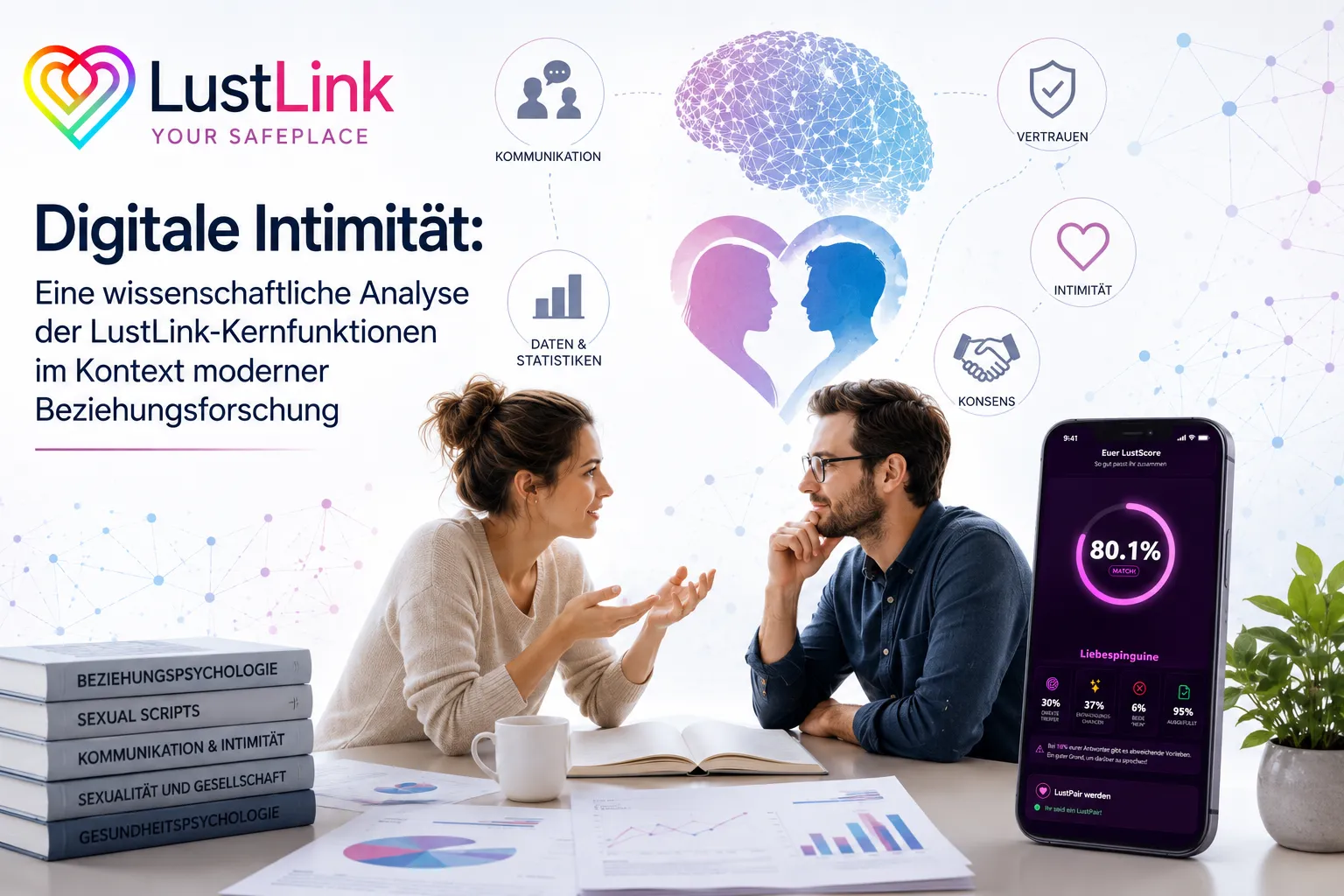
In contemporary relationship science, the quality of dyadic communication is evaluated as the primary predictor of relationship stability and interpersonal cohesion. While academic theory provides robust evidence for the vital role of open dialogue, everyday practice frequently reveals a persistent divide driven by shame, perceived social costs, and a lack of methodological communication tools. Digital instruments serve as a vital bridge, transforming abstract theoretical frameworks from clinical sexology into exploratory, accessible applications.
Central to understanding successful intimacy are “dyadic sexual communication skills.” According to Döring and Byers (2025), these encompass the verbal and nonverbal competencies required to exchange meaningful sexual information before, during, and after an erotic encounter. These competencies are essential for experiencing sexual fulfillment not as an accidental byproduct, but as the deliberate outcome of ongoing negotiation and mutual attunement.
Interpersonal dynamics are largely steered by “Sexual Scripts” (Simon & Gagnon, 2003), which operate on three distinct levels:
- Intrapsychic Scripts: Individual fantasies, desires, and motivational schemas.
- Interpersonal Scripts: Concrete interactions and the dyadic synchronization of desires between partners.
- Cultural Scripts: Societal norms and conventions that dictate the boundaries of what can be voiced.
The central challenge in modern romantic relationships lies in translating intrapsychic desires into functional interpersonal scripts despite cultural inhibitions. This psychological transformation finds its technological realization in the architecture of specialized platforms like LustLink.
The Health Belief Model (HBM) as a Framework for Digital Interventions
The Health Belief Model (HBM) offers a robust theoretical framework for analyzing digital sexual health interventions. It posits that an individual’s willingness to engage in preventive or exploratory actions depends on their subjective balance between perceived threats and barriers. In human sexuality, perceived barriers—most notably stigma and fear of rejection—often heavily outweigh the anticipated benefits.
Research by Nilüfer Geysi (2026) conceptualizes digital sexual communication as proactive “barrier management.” To foster readiness to act, technological environments must actively dismantle shame and construct validated psychological safety. The following synthesis contrasts the core dimensions of the HBM with the specific challenges of intimacy and the strategic solutions identified by Geysi:
- Perceived Susceptibility: Recognizing that routine and silence can erode dyadic bonding over time. (Strategy: Cognitive Correction—providing relationship psychology insights to foster awareness).
- Perceived Severity: Fear of emotional alienation, estrangement, or the complete loss of sexual intimacy. (Strategy: Emotional Safety—validating anxieties within a discreet, clinically grounded space).
- Perceived Benefits: The prospect of enhanced affect regulation, mutual pleasure, and sexual vitality. (Strategy: Structural Advocacy—framing sexual fulfillment as an integral component of holistic health).
- Perceived Barriers: Shame, fear of judgment, and the interpersonal friction of vulnerability. (Strategy: Normalization—destigmatizing exploration through anonymous matching mechanics and no-shame principles).
- Cues to Action: Experiencing an impasse in articulating intrapsychic desires such as kinks or fantasies. (Strategy: Instructional Guidance—providing guided exploratory tools such as LustScore and the Bucketlist).
This psychological relief through barrier management is engineered directly into the consent-focused architecture of LustLink.
LustLink in Focus: Functional Implementation of Scientific Concepts
LustLink operationalizes clinical concepts from relationship psychology through an architecture that prioritizes privacy, bilateral consent, and emotional safety. By utilizing invite codes instead of public profiles or real-name registries, the interpersonal vulnerability associated with sexual exploration is drastically reduced.
An examination of LustLink’s core features reveals direct alignment with the “Gottman Method,” which identifies friendship, mutual fondness, and shared meaning as foundational pillars of a resilient couple:
- The Matching Principle (LustPairs): This feature acts as a technological buffer against Gottman’s “Four Horsemen” (Criticism, Contempt, Defensiveness, Stonewalling). Because only mutually shared preferences are ever revealed, the system completely neutralizes the fear of rejection. It automates the “Gentle Start-up”: interactions proceed exclusively from an already validated common ground, preempting negative affective spirals.
- LustScore & Statistics: These tools facilitate cognitive re-evaluation, helping partners situate their erotic preferences beyond prevailing cultural myths, thereby replenishing the couple’s “emotional bank account.”
- Wishlist & Bucketlist: These features help couples transition from communicative paralysis into proactive dialogue regarding essential sexual curiosities.
Through these mechanisms, intrapsychic desires are translated securely into healthy interpersonal scripts within a validated structure.
Overcoming Stigma and Shame: The “No-Shame” Principle
Societal taboos frequently inhibit the expression of non-conforming desires, such as kinks or fetishes. Drawing on Geysi’s (2026) concepts of “Emotional Safety” and “Normalization,” LustLink systematically deconstructs these communicative obstacles. A cornerstone of this approach is Structural Advocacy: the platform frames sexual well-being not merely as an individual burden, but as a legitimate and essential dimension of life satisfaction and relational health.
To achieve cognitive correction and dismantle pervasive sexual myths, LustLink relies on three primary strategies:
- Myth Correction Through Evidence: The educational magazine provides psychoanalytic and historical analyses (e.g., addressing misconceptions regarding age-gap relationships) to objectively refute feelings of “abnormality.”
- Peer Validation: Aggregated, anonymized statistics reassure users that their specific kinks are widespread facets of human sexual diversity, alleviating feelings of isolation.
- Structural Security: Robust privacy architecture (BuddyLink, end-to-end encryption) delivers an implicit security prime, replacing shame-driven defensiveness with emotional safety.
The mitigation of shame is the indispensable conditio sine qua non for couples to proactively co-create their erotic future.
From Fantasy to Practice: Collaborative Exploration and the Bucketlist
For enduring relationship satisfaction, “rituals of connection” and the attainment of “instrumental goals” (the initiation of shared sexual activities) are of paramount importance. Döring and Byers (2025) distinguish between expressive-affective goals (enhancing intimacy and emotional closeness) and instrumental goals (concrete behavioral realization); LustLink systematically facilitates both.
The sexual bucketlist serves as an instrument for constructing nuanced “Love Maps” (Gottman). It promotes sexual self-disclosure based on the validated subscales of Snell et al. (1989), particularly within the domains of “Sexual Behaviors” and “Sexual Feelings.” Structured across 72 items (analogous to the SSDS), the bucketlist enables couples to articulate specific behaviors, boundaries, and emotional aspirations that often remain unspoken in everyday life.
Consider LustLink an instrument for playful “emotion coaching.” The platform enables you to refine your dyadic synchronization and embark on new erotic ventures as collaborative, consent-based explorations. This shared journey is an ongoing developmental process that deepens mutual attachment through co-created “maps of desire.”
Conclusion: The Synergy of Science and Technology
Scientific findings on dyadic communication can only unleash their full preventive and therapeutic potential when woven into the fabric of daily romantic life. LustLink synthesizes these empirical insights into a digital “safe space” that not only facilitates dyadic sexual competencies as defined by Döring and Byers, but clinically reinforces them.
By dismantling HBM-defined barriers and operationalizing Gottman’s foundational principles, the application serves as a catalyst for sexual intelligence. In an era of profound digital transformation, LustLink provides a crucial scaffolding for couples seeking to deepen intimacy through authentic, secure, and evidence-based communication.
References and Further Reading
- Catania, J. A. (2011): Dyadic Sexual Communication Scale (DSCS). Handbook of Sexuality-Related Measures. Routledge.
- Döring, N. & Byers, E. S. (2025): Dyadic Sexual Communication Skills. Encyclopedia of Sexual Psychology and Behavior. Springer Nature Switzerland.
- Geysi, N. (2026): Digital Sexual Health Communication: An Analysis of Tabukamu’s Content from a Health Belief Model Perspective. Akdeniz Journal of Communication Studies (52), 29-45.
- Gottman, J. M. & Gottman, J. S.: The Gottman Method in Couples Therapy. (gottman-methode.de).
- Simon, W. & Gagnon, J. H. (2003): Sexual Scripts: Origins, Influences and Changes. Qualitative Sociology, 26(4).
- Snell, W. E. et al. (1989): Sexual Self-Disclosure Scale (SSDS). Annals of Sex Research, 2(4).
- Additional Resources: Couples Therapy Practice Hamburg (“100 Questions for Couples”); Teach LOVE (Dilemma Game - Relationship Game for Couples); Recoupling App.
Research and draft supported by AI, editorially reviewed.
Helpful article?
Loading ratings...