
Introduction: The Paradox of Desire
The human pursuit of pleasure is one of the most primal engines of our existence, yet it harbors a profound paradox. We all recognize the urgent craving for an objective that, the moment it is attained, leaves us feeling oddly hollow.
Why is pleasure often so fleeting, and why can craving sometimes feel downright destructive? For centuries, this tension was the exclusive domain of philosophers and moral theologians, debating between crowning pleasure as life’s supreme purpose and condemning lust as a deadly sin.
Today, advanced neuroimaging and biochemical research provide a look behind the curtain of our subjective experience. The journey leads from ancient thinkers deep into the subcortical structures of the human brain, revealing that desire is no crude reflex, but an intricate, often contradictory interplay of evolution, neurochemistry, and psychology.
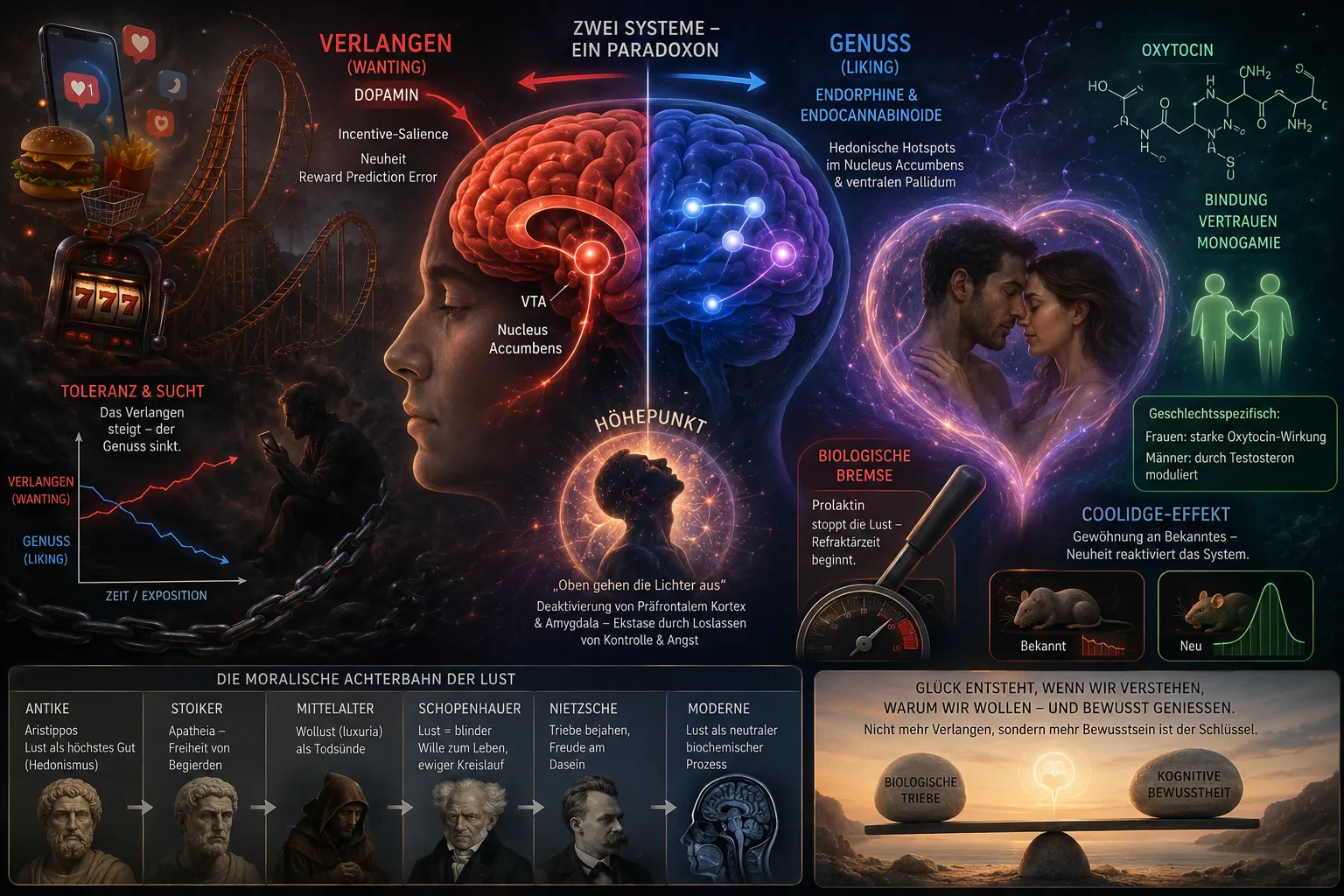
The Dopamine Misconception: Wanting Is Not Liking
In popular science, dopamine is routinely mischaracterized as the “happiness hormone.” The Incentive-Salience Theory formulated by neuroscientists Kent Berridge and Terry Robinson firmly dismantles this myth.
Their seminal discovery cleanly bifurcates two distinct neurological systems:
- Wanting = Craving, motivation, incentive salience, and drive
- Liking = Authentic sensory pleasure, hedonic enjoyment, and subjective satisfaction
Wanting
Wanting is mediated by dopaminergic circuits within the mesolimbic system. It originates in the ventral tegmental area (VTA) and projects into the nucleus accumbens. This circuitry responds with acute sensitivity to the Reward Prediction Error—firing intensely whenever a reward proves more unexpected or superior to prior forecasts.
Liking
Genuine pleasure, by contrast, is generated within localized hedonic hotspots situated in the nucleus accumbens and the ventral pallidum. These micro-sites are driven primarily by endogenous opioids (endorphins) and endocannabinoids—not dopamine.
This neurochemical divergence explains why humans can pursue objectives with feverish obsession even when attainment yields virtually no genuine pleasure. In addictive disorders, the dopamine wanting-system becomes hyper-sensitized: craving escalates exponentially, while actual hedonic satisfaction (liking) steadily deteriorates.
”The Lights Go Out Upstairs”: The Brain at Peak Orgasm
Functional MRI (fMRI) studies capture a mesmerizing neural signature during orgasm. While midbrain reward centers and the cerebellum exhibit explosive activation, cortical networks dedicated to executive control, vigilant monitoring, and anxiety are concurrently shut down. Most notably, metabolic activity plummets in the prefrontal cortex and the amygdala.
“Neurobiologically speaking, the lights go out upstairs.”
Only through this transient cortical silence are vigilance and inhibition suspended, unlocking uninhibited ecstasy. The delicious irony of human neurobiology: the supreme summit of sensory consciousness demands the temporary deactivation of the very cerebral structures that render us rational beings.
The Biological Brake: Why Desire Has an Expiration Date
In the wake of climax, the endocrine system releases substantial surges of prolactin. This hormone operates as dopamine’s natural antagonist, initiating the physiological refractory period.
The Coolidge Effect
Another pivotal phenomenon is the Coolidge Effect. The mammalian brain adapts rapidly to familiar stimuli through habituation, causing dopamine release to taper over time. Novel stimuli, conversely, instantly re-ignite the reward pathway.
From an evolutionary standpoint, this mechanism fostered genetic diversification. In the context of committed, long-term relationships, however, it creates a persistent somatic tension between the biological impulse for novelty and the emotional yearning for security and attachment.
From Sin to Synapses: The Moral Rollercoaster of History
Cultural appraisals of erotic desire have oscillated dramatically across epochs:
- Antiquity: Aristippus exalted sensory pleasure as life’s highest virtue.
- Stoicism: The Stoics cultivated complete freedom from turbulent passions (apatheia).
- The Middle Ages: Voluptuous desire was demonized as a mortal sin.
- Schopenhauer: Interpreted erotic desire as the blind, tormenting machination of the metaphysical Will to Life.
- Nietzsche: Championed the triumphant affirmation of drives, passions, and vital existence.
- Modernity: Analyzes desire primarily as a neurochemical mechanism rather than a moral failing.
Oxytocin: The Neurobiology of Bonding
Oxytocin bridges transient hedonic spikes with enduring emotional intimacy. It attenuates amygdala-driven anxiety, softens relational defenses, and facilitates deep interpersonal trust. Within the Dual Control Model of sexual response, oxytocin functions like an agent that eases the neurological brakes on sexual arousal.
Concurrently, the hormone carries complex social dimensions, occasionally reinforcing in-group favoritism while heightening out-group wariness.
Sex-Specific Nuances
- Women frequently exhibit higher neuro-receptor sensitivity to oxytocin surges.
- Elevated testosterone can attenuate oxytocin-induced bonding cues in men.
- Fluctuations in circulating estrogen dynamically modulate oxytocin receptor density.
Nevertheless, oxytocin underpins lifelong biological reward learning: transcendent sexual pleasure becomes somatically associated with the partner, cementing durable trust and relational attachment.
Conclusion: Toward a New Science of Fulfillment
Desire is far from a primitive switch. It emerges from an intricate tapestry woven of evolutionary survival scripts, neural circuitry, psychological needs, and cultural paradigms. Distinguishing sharply between Wanting (the obsessive urge) and Liking (the serene savoring) illuminates countless contradictions in human sexual behavior.
This insight poses a penetrating question for contemporary life:
Does our modern hyper-stimulated landscape—inundated with dopamine-triggering algorithms, fast food, and endless digital novelties—insidiously erode our neurological capacity for authentic, deep pleasure?
Perhaps genuine erotic fulfillment does not consist of perpetually wanting more. Perhaps it lies in relearning how to truly savor what is already here.
Researched and drafted with AI support, editorially reviewed.
Helpful article?
Loading ratings...